 |
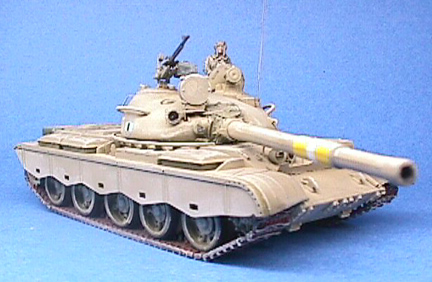
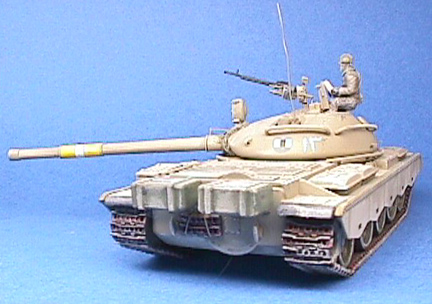
| The t-62
went into production in 1961 as a replacement for the battle proven T-54/55
series, however it never quite lived up to expectations due to it's much
higher cost and only slightly better performance. The t-62 became the
standard main battle tank in Soviet tank and motorized rifle units with
production ending in 1975. The t-62M variant (also known as t-62A) first
appeared in 1970. |
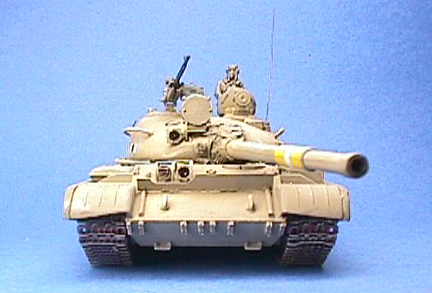 |
| The most
significant improvement over the T-54/55 tank is the stabilized 115-mm
smoothbore main gun which fires a hypervelocity, armor-piercing, fin-stabilized,
discarding sabot (HVAPFSDS) round. |
 |
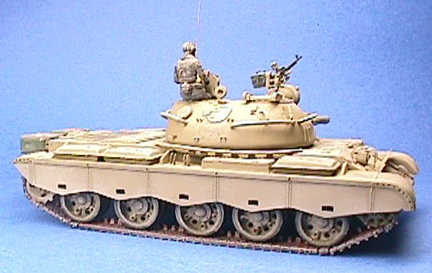
| The
Iraqi t-62M proved to be completely outclassed during the Gulf War. It's
cramped crew compartment, thin armor, limited depression of main gun, and
vulnerable fuel and ammunition storage areas contributed to extremely heavy
losses against the alliance. |
 |
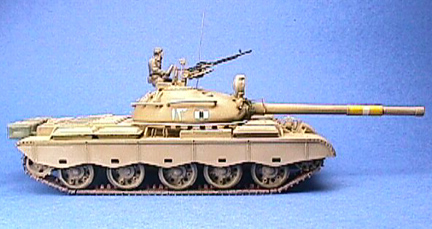
| The
t-62 has an automatic spent-cartridge ejection system that can cause dangerous
accumulations of carbon monoxide in the turret and is notorious for causing
physical injury to the crew. Each time the gun is fired, the tube must go
into detente for cartridge ejection and the power traverse of the turret
is temporarily inoperable. |
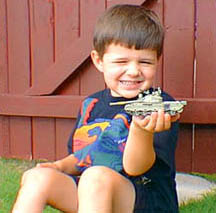 |
| My
son Chris (at the time 4 years old) assisting me during the original photoshoot. |
 |
| This
kit was my first entry into a judging event of any kind. I took it to Squadron
Scalefest 1994 and it placed third in it's division out of about 13 entries. It was also the first kit that I attempted to detail and weather accurately.
I've never been able to go back to building straight out of the box since
then, which is sometimes regrettable since I complete only a fraction as
many kits this way. |
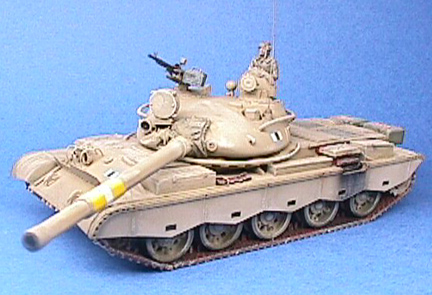 |
| At the time I built this kit it was the only T-62 on the market in the scale. It still stands up well although there are several other choices now with better and more accurate details. |
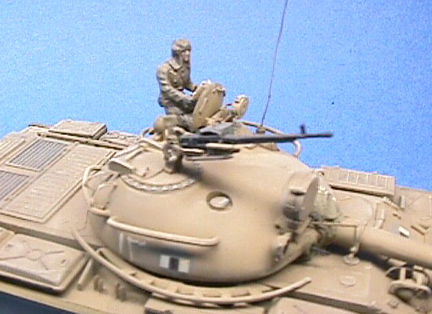 |
| This tanker's upper body came from an ESCI T-34. I spliced him to a spare lower body and he finished this tank out nicely. |
| t-62M
Specifications |
Crew: 4 |
Combat
Weight : 41.5mt |
Dimensions:
Length: 6.36m x Width: 3.52m x Height: 2.4m |
| Maximum
Speed : 45km/h (road) |
Range :
280km (cross-country), 450km (paved roads), or
400km
(cross-country), 650km (paved roads) with two
200-liter external fuel tanks added. |
Fording
Depth :
1.4m (unprepared), 5.5m (with snorkel) |
| Engine): 580-hp V-12,
water-cooled diesel engine. |
Main
Armament :
115mm smoothbore gun (2A20/Sheksna ) with basic load of 40 mixed rounds.
7.62mm (7.62x 54R) machinegun PKT (coaxial)
12.7mm DShK antiaircraft machinegun |
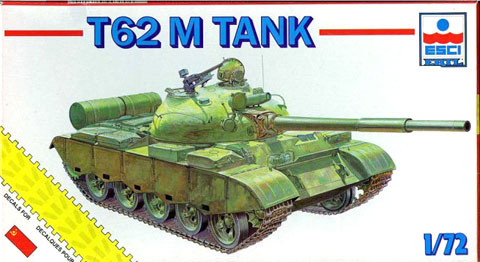 |

Kit: ESCI/ERTL # 8341 |

Scale: 1/72 |
| Cost: I
purchased this kit for $4.99 (US) in 1993. It has been out of production
for quite some time but still can be found for around $10.00 (US)
from time to time. Still a great value. |
| Review: This
kit is fairly easy to build with no major assembly problems. Filler
and sanding is required in some places namely the upper to lower hull
joints and upper to lower turret joint. Detail is good overall with
the exception of the oversimplified roadwheels which are one solid wheel instead of an inner and outer wheel. A bit of drilling
and whittling is needed to correct this problem.
Separately molded track links are provided. (At the time this kit
was released, separate links were rare and ESCI was among the very
first to have them) The tie-down handles surrounding the turret are
way too thick and tall. The loader's 12.7mm AA gun is represented
fairly well. |
| Decals: I hand
cut masks and airbrushed all markings. |
| After
Market Parts: Eduard's
Photo Etched Parts kit. |
| Customizations: Commanders
hatch was opened up. I applied tissue paper wet with water and white
glue to the glacis plate. Roadwheel spokes were drilled out and carved
to look more like separate inner/outer wheels. Track link "teeth"
were added with small trimmed pieces of styrene. Figure is a modified
ESCI T-34 commander. I used scale ammo crates from my spare parts box
instead of the provided auxiliary fuel tanks at the rear of the vehicle.
I created the details on the lower front of the with scraps of styrene. |
| Research: I
used (almost exclusively) Cookie Sewell's article "Building an
Iraqi t-62M in 1/35 scale" out of the July 1994 issue of FineScale
Modeler. |