|
The B-1B Flight Simulator
(My 30 minutes of being a bomber pilot)
|
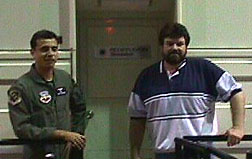 |
| This is Captain John deAndrade (left) and Michael (right) standing in front of the Forward Cockpit Simulator. Captain deAndrade was my flight instructor for the day and he barely made fun of my flying skills at all (at least not while I was still there). |
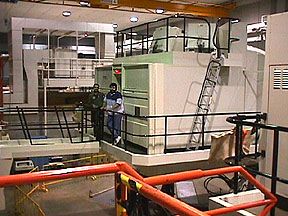 |
| This photo gives a much better perspective of how large these simulators are. There are two front and two rear compartment simulators in the room. |
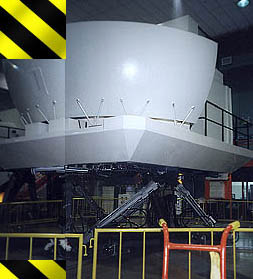 |
| The simulators sit on top of massive hydraulic arms that can really make the experience feel real. |
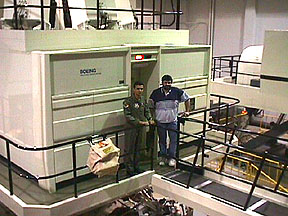 |
Once the "plank" is retracted you are basically stranded on a small island up in the sky. Inside this room is a complete B-1B cockpit with virtually every control operational except for the ejection handles - which was a good thing since I accidentally flew through a simulated mountain somewhere in Utah.
Unfortunately my photos of the interior were mysteriously corrupted. I figured it was due to an anti-spy security system, but Mike assured me it was just operator error. |
| |
| My Simulation Flight |
Inside the simulator is an entire front cockpit of a B-1B, with
extra room aft for an instructor and his control station. You step over the center console and sit right
down in your Aces II ejection seat and get ready to fly.
Due to the fact that we only had a half hour of "flying" time ,
Capt. deAndrade cheated on the normal flightcheck list and just started the
engines up right away. The cockpit started rumbling with the simulated
sound of four F101-GE-102 turbofan engines.
Looking through the windscreen,
I could see that we were parked on the tarmac at Hill Air Force Base and could see the runway that
we needed to taxi to. Captain deAndrade had me add some throttle and few seconds later we were rolling along the taxi way feeling the bumps in the tarmac as we
went. The B-1 was fairly easy to drive on the ground although I don't think I could parallel park it.
I pushed
on the left rudder pedal to turn towards the runway, then right
pedal to straighten out. To brake, you push on the tops of the pedals.
Although the B-1 was designed decades ago, the cockpit looks fairly modern. The main MFD directly in front provided most all
of the information I needed to fly. The only other display I had to monitor was the engine throttle indicators (I'm sure real pilots monitor all the other gizmos too, I was nearly overloaded just trying to keep up with
all the info in the main display). The B-1 has a fighter-style control stick which is warranted
since this bird handles much more like a giant fighter than a lumbering bomber.
Once I was lined up on the runway, Captain deAndrade gave me the go-ahead to let off the brakes and push
the throttles all the way forward. The engine noise really increased and we started picking up speed. As I reached the proper speed I pulled back on the control stick until my mfd indicated a 10 degree climb and at once we were off the ground.
I retracted the gear and started climbing to meet up with our KC-135 to take on fuel. At first it seemed like it was going to be easy but as the tanker grew larger and larger in my windscreen it got more and more difficult to get lined up and stay in position. The entire process was
very realistic and and it was nerve racking trying to purposely aim your cockpit glass at big metal boom hanging out of another aircraft.
This was easily the most difficult part of the mission for me.
The B-1 is very responsive and I was way too heavy handed so the captain had to take over after 3 failed hookups. He hooked up on his first try and made it look pretty easy but as we started to take on fuel we hit a little turbulence and lost connection, he managed to make the reconnect look a little more difficult (maybe just to make me feel better). He later told me that almost nobody
hooks up on their first try.
Once we were topped off I took the controls again and dove towards the ground
to start our Nap Of the Earth flight through the Colorado Mountains.
While in the dive, I felt a big "bump"
and the captain pointed out that I had broken the sound barrier which would have gotten me into big trouble
over the continental United States.
Flying low in the valleys was great fun because the B-1 has the
power and the airframe to roll 90 degrees and peel up the next canyon without
any problem. I thought I was really cutting it close until Captain
deAndrade took the controls and put us right on the deck. I think Captain deAndrade
could fly the Death Star trench without any use of The Force.
The final part of my flight was a few touch-and-go landings at Hill
AFB. I thought I did this quite well, but the aircraft's instrument systems are so good that you pretty much just follow what the display tells you to do and next thing you know you've landed.
The time went by really fast and although I'm not sure how much I retained, I felt fairly comfortable at the controls by the time it
was over. |

Go to Page 2 |


